Electrification of process heat
Decarbonisation of the brewing process
Beer production requires significant amounts of electrical and thermal energy. Whilst electricity can already be sourced from renewable sources, the production of process heat is still largely based on fossil energy sources today.
EquiThermPower is rethinking the thermal energy supply in breweries.Heat pumps and steam compressors are used to raise the temperature of existing thermal energy electrically to a higher level and feed it back into the production process. In this way, energy efficiency and decarbonisation are linked.
At a glance
- EquiThermPower converts electrical energy into thermal energy and also makes unused waste heat usable for the production process.
- This reduces CO₂ emissions and consistently integrates renewable energy into the thermal energy supply.

Application areas
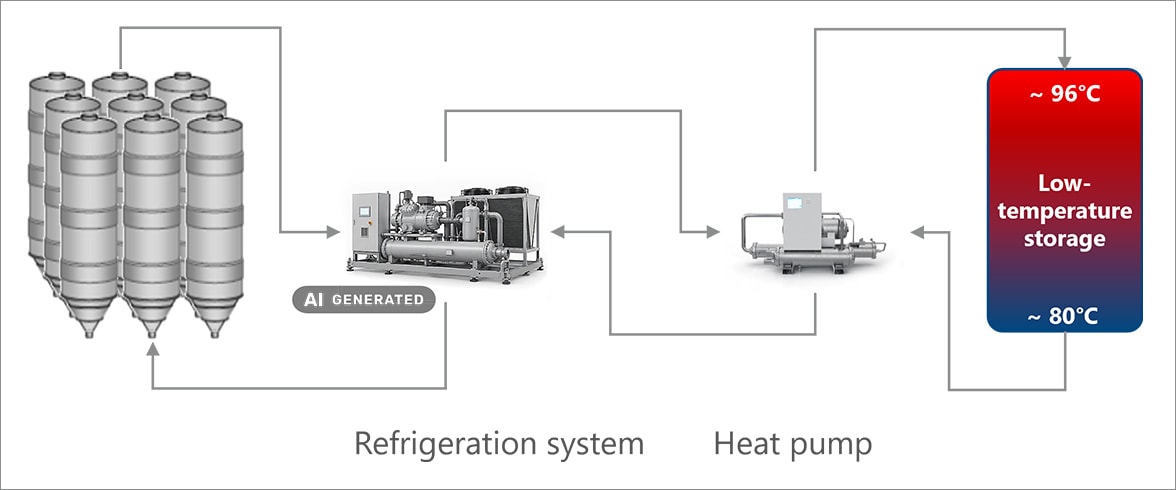
From energy loss ...
- Fermentation continuously generates heat, which is dissipated through the tank cooling system.
- This energy is transported via the cooling circuit to the refrigeration system, where it is absorbed by the refrigerant and released again on the condenser side.
- Until now, this waste heat has often been released into the environment without being utilised, and is thus lost to the production process.
... to resource
- Due to its low temperature, the waste heat cannot be used directly as process heat.
- A heat pump recovers and raises the existing waste heat to a usable temperature level. As a result, the heat originally dissipated during fermentation becomes available once again as valuable process heat.
A system with dual benefits
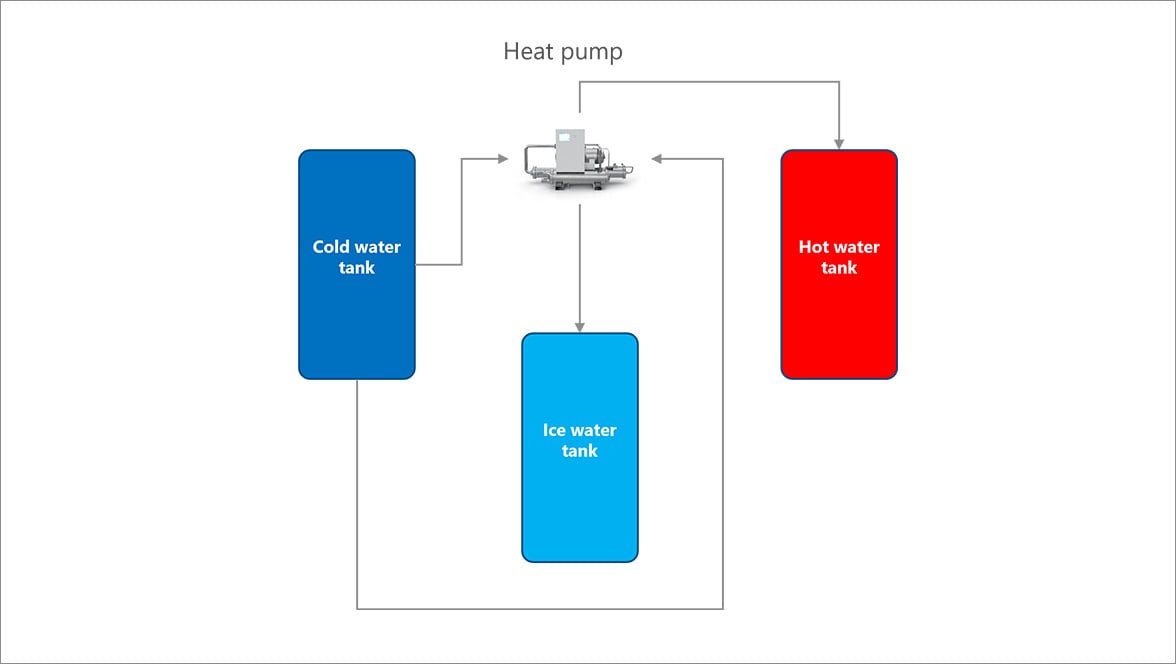
- Traditionally, ice water and hot water are produced independently of one another:
- For the hot water production, thermal energy is required.
- For ice water production, electrical energy is used to generate refrigeration.
- A heat pump combines both processes: The heat absorbed during ice water production is no longer simply dissipated without being utilised; instead, it is specifically used to generate hot water.
- The used electrical energy is thus utilised especially efficiently. By considering both the cooling and heating output together, a total coefficient of performance of up to 8 can be achieved.
From heat storage to wort boiling
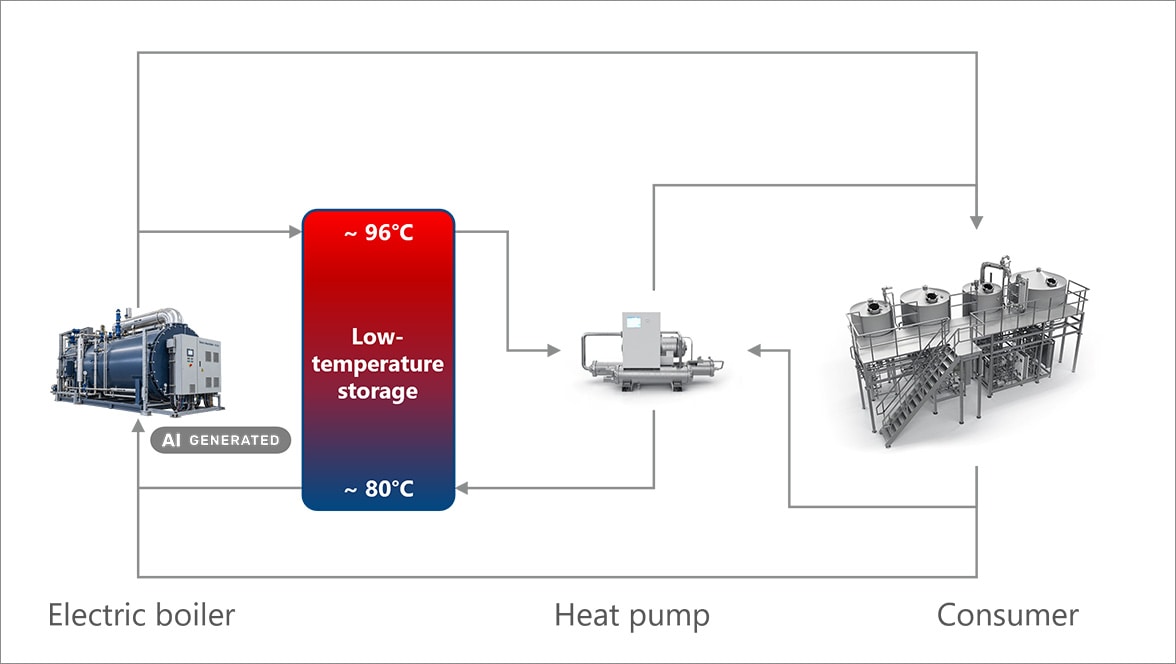
- Many thermal consumers in the production process can be supplied directly from the low-temperature storage tank.However, this temperature level is not sufficient for processes that require higher temperatures, particularly wort boiling or sterilisation.
- A heat pump specifically raises the existing heat to the required temperature level and provides the necessary process heat using electrical energy.
- This makes it possible to use renewable electricity even for high-temperature applications and to further reduce the use of fossil fuels.
Sustainable steam production
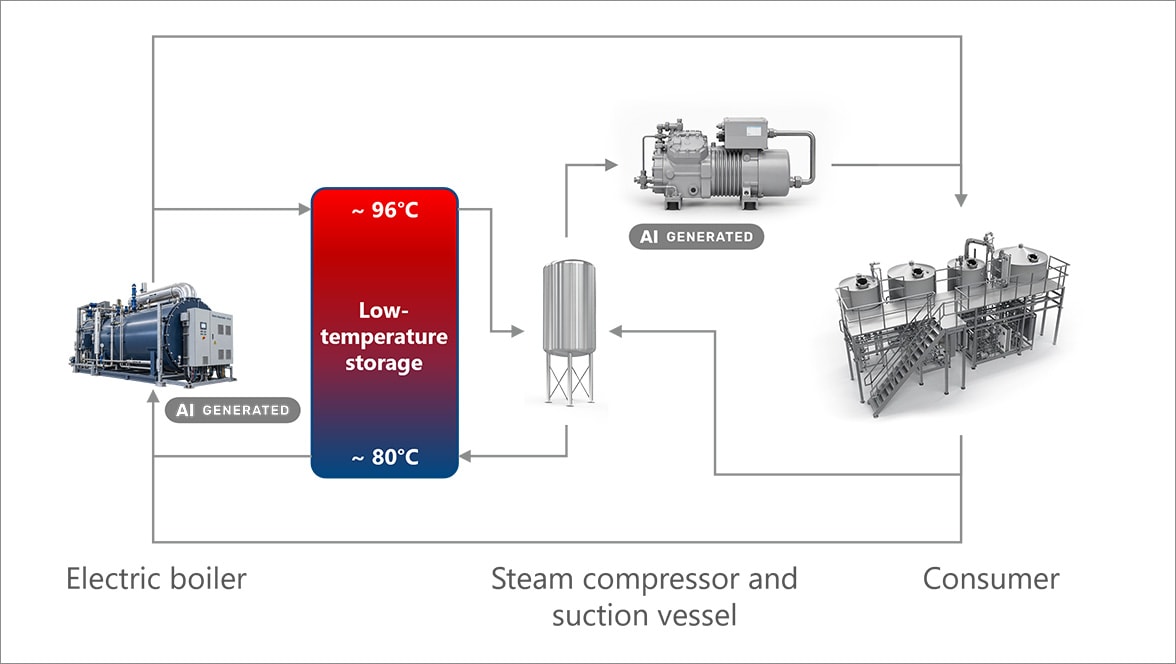
- Hot water from the low-temperature storage tank creates a vapour-saturated atmosphere in the evaporator vessel.
- The water vapour is compressed by an electrically driven compressor, thereby raising it to a higher pressure and temperature level.
- The steam generated in this way can then be fed into the existing steam distribution network and used by the respective process heat consumers.
- This makes it possible to electrify steam generation and further reduce the use of fossil fuels.
Flexibility for the food and beverage production
One principle –many possibilities
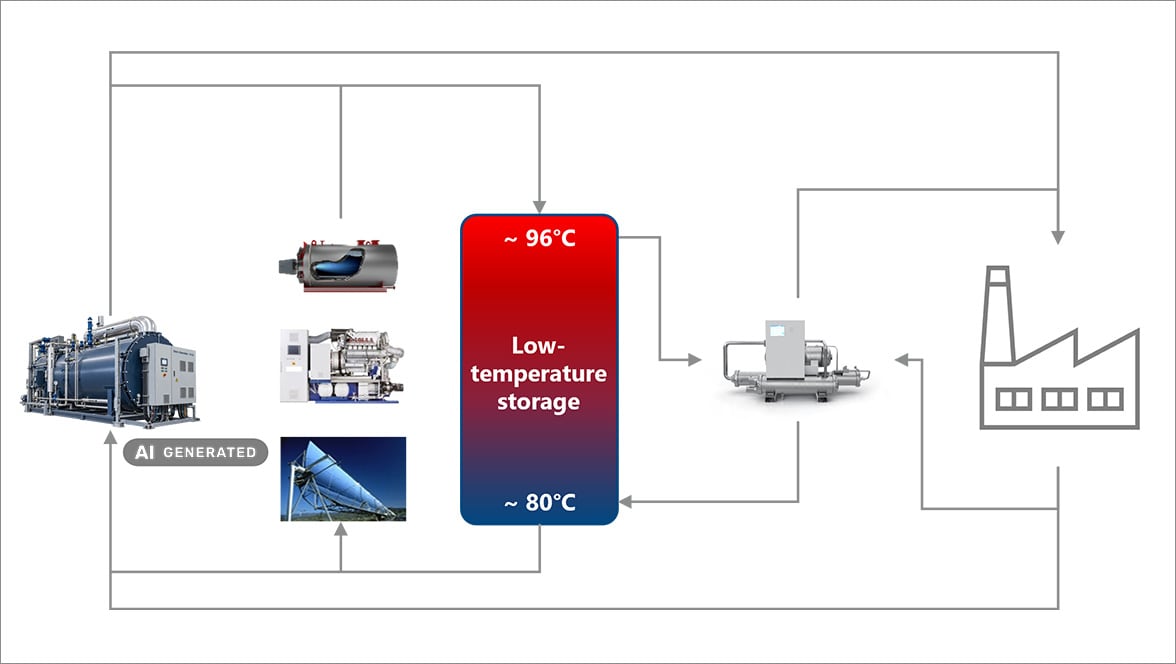
- The low-temperature storage tank decouples the generation and consumption of heat in terms of time. This allows standardised heat pump modules to be used efficiently as required.
- At the same time, the integration of alternative heat sources enables flexible line operation and makes it possible to respond specifically to fluctuations in energy prices and energy availability.
Alternative heat sources:
- Biogas boiler
- Combined heat and power unit
- Solar thermal energy
Benefits to you
Easy to retrofit
The flexible configuration permits the integration into existing energy systems. The implementation itself requires only minimal changes to the existing infrastructure.
Reduction of load peaks
The low-temperature storage tank prevents load peaks, which enables the use of small, standardised components. The low space requirement and low investment costs enable an economic use even in existing lines.
Independence from fossil energy sources
By preventing heat loss and utilising electrical fuels, the consumption of fossil fuels can be reduced. This reduces the dependency on volatile energy prices and results in an increased security of supply.
Use of electricity generated from renewable sources
The system uses electricity as a locally emission-free energy source, thereby enabling the use of electricity generated from renewable sources.